


Cherry Blossoms and Choice: Why Beauty Changes How We Think

There's a brief window in New York City when everything softens. The pace. The noise. Even the way people move. It happens when the cherry blossoms bloom, and it turns out that's one of the most useful things that can happen to your brain.
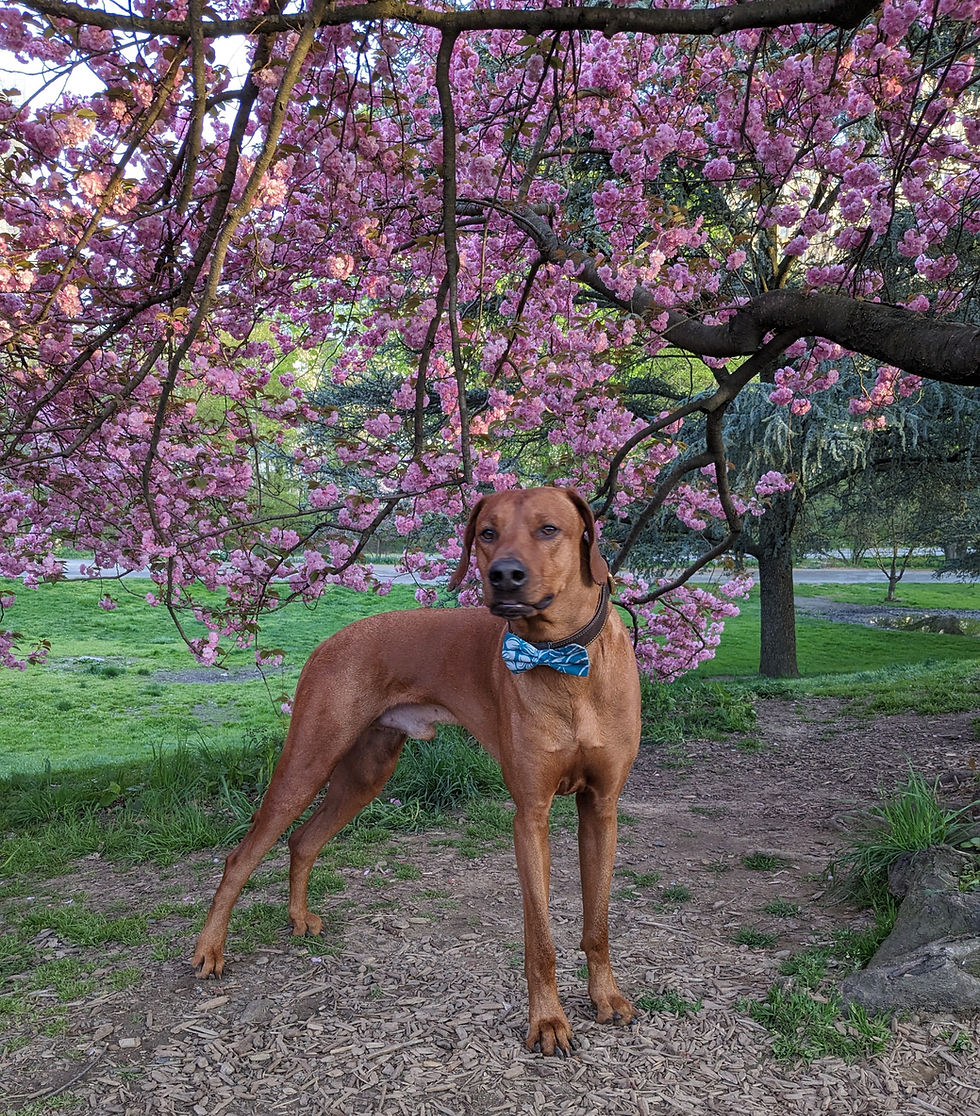
Last week I took Koa on what I thought was going to be a quick morning loop through Prospect Park. We made it maybe four minutes before he stopped cold on the path, nose lifted, tail going. I looked up to see what had caught his attention and it was a wall of cherry blossoms, backlit by early sun, petals drifting sideways in the wind like slow pink snow. We stood there for a while. Neither of us was in a hurry anymore.
You'll see the same thing across the city right now. People pausing mid-stride near Central Park or along the paths of Brooklyn Botanic Garden. Phones out, conversations quieting, heads tilted up. It feels like a break from reality. But it's more than that. It's a shift in how we think.
The science of awe
Awe is a powerful emotional state triggered by something vast, beautiful, or beyond our normal frame of reference. Cherry blossoms, fleeting and seasonal and almost impossibly delicate, are a near-perfect example. And for a long time, awe was treated as a soft, subjective thing. A mood. Nothing you'd put in a lab. Then researchers started actually studying it, and what they found was surprising.
The research
Research in Positive Psychology shows that experiences of awe reliably change how people think and decide. People who had recently experienced awe were measurably better at thinking through complex problems, less likely to make snap judgments, and more willing to sit with uncertainty before arriving at a conclusion. Awe has been shown to expand perception of time, reduce stress and self-focus, increase cognitive flexibility, and improve the quality of decisions. It doesn't just make you feel good. It changes how your brain processes the world.
What's doing much of the work here is time, specifically the feeling of having more of it. When researchers asked people to recall an awe experience and then rate how much time they felt they had, those people consistently reported feeling like they had more available, even when objectively they had the same amount as everyone else. Awe expands your perceived time horizon. And that matters enormously for how you make choices.
Why beauty slows down your thinking
In a fast-paced environment like New York, most decisions are made quickly and often automatically. You react. You choose. You move on. But when you encounter something beautiful, your brain does something different. It pauses.
Psychologists call this a shift from fast, reactive thinking to slower, more deliberate cognition. Instead of scanning for efficiency, your mind takes in more detail, processes more context, and becomes less impulsive. That slowing down isn't inefficiency. It's precision.
"When we feel rushed, our thinking narrows. We reach for the familiar, the fast, the first option that seems good enough. Awe interrupts that."
When your thinking slows, something important follows: you make better choices. Not because you're thinking more, but because you're thinking differently. Awe has been shown to reduce reliance on cognitive shortcuts and biases, increase patience and long-term thinking, and improve ethical and prosocial decision-making. You're less reactive in conversations. More thoughtful about your priorities. More aligned with what actually matters to you.
In a city built on speed, that's a genuine advantage.
What this looks like in real life
The rushed morning
Coffee in hand, mentally already in your next meeting. Then you pass a row of blossoms on the bridle path. You slow down, even for a few seconds. That next decision you make is less rushed. More intentional.
The overwhelmed afternoon
Too many decisions. Too many inputs. A quick walk near Brooklyn Botanic Garden shifts your mental state. You return not just calmer, but clearer.
The big decision
You've been circling it for days. And then, unexpectedly, clarity comes not at your desk, but outside, in a moment of stillness under a flowering tree.
What Koa understands instinctively
Koa doesn't analyze cherry blossoms. He doesn't optimize the route or think about what's next. He just stops. He notices. He lingers longer than necessary, sniffing the air, watching petals fall, fully present in the moment.
Field notes with Koa
Walking with Koa during this time of year subtly changes how I experience the city. I slow down. I look up more. I pause without needing a reason. He has stopped me in my tracks in Prospect Park more times than I can count, and I've never once regretted it. He approaches every cherry blossom with the same slow, thorough attention he gives to everything he considers worth investigating, which is most things. The researchers studying awe in children found that kids enter the state far more easily than adults, partly because they haven't yet learned to dismiss things as already-understood. Walking with a dog is a good way to get some of that back. Those small pauses carry over into everything else, especially how I make decisions.
In doing so, Koa does something most of us have to consciously relearn: he allows the environment to shape his state of mind. And the science says he's onto something.
A practical way to use this
You don't need to block off hours or leave the city to think more clearly. You just need to create moments of awe, intentionally.
Try this
Take a 10 to 15 minute walk during peak bloom. Leave your phone in your pocket. Let yourself pause when something catches your attention.
Even a few minutes is enough to shift your cognitive state. The goal isn't to escape the city. It's to experience it differently.
The Brooklyn Botanic Garden. The bridle path in Central Park. The rows of Yoshino cherries near the Met on the East Side. The single trees blooming out front of brownstones in Cobble Hill like they forgot they were supposed to be ordinary. These places aren't just beautiful. According to the science, they're active environments for better thinking.
Awe: Triggered by beauty or vastness. Signals your brain to slow down and open up.
Time expansion: Awe grows your perceived time horizon. You feel less rushed even when nothing changed.
Better decisions: Slower cognition engages deliberate reasoning. You think instead of react.
The deeper insight
We often think better decisions come from more effort, more analysis, more time at the desk. But science suggests something else: sometimes, better decisions come from stepping away and allowing your mind to expand before it narrows.
One of the consistent findings in awe research is what they call the "small self" effect: a temporary, comfortable sense that you are a small part of something much larger. This sounds like it could be deflating, but it isn't. People in the small self state report feeling more connected, more generous, and paradoxically more present. Less wrapped up in whatever private story they've been telling themselves all week.
Cherry blossoms don't last. That's part of why they work. The window for Yoshino cherries in New York is typically ten days to two weeks, and this year's been warmer, so it may already be tightening. But the way they change how you think, that slowness, that opening, that's something you can carry with you.
"In a place defined by speed, choosing to slow down is intentional. And in that pause, you create space for better thinking, clearer judgment, and more meaningful choices."
Sometimes the smartest move you can make is to stop and look up.
Koa's final word
And if you happen to have a dog like Koa beside you, you might just be reminded to stay there a little longer. He has officially ranked the cherry trees along the Boathouse path in Prospect Park as worth stopping for multiple times on a single walk. The petals fall on you and you don't mind at all. I defer to his judgment on this completely.


Comments